5-day urban retreat · Budapest · January 2–6, 2027

Five qualities of
basic goodness

Maitri Space Awareness – the power of presence

Five days in the space of bare awareness: experience the rainbow of the five basic energies that shape our inner and outer worlds – and the warmth of gentle, non-judgmental attention. Our exploration will use color, posture, spatial awareness, meditation, and different forms of artistic expression to make the distinct qualities of the five energies directly experiential.

Maitri circular logo: five colors within a golden ring

About the retreat

About the retreat

The spirit of the Maitri retreat

We’re offering this retreat in the spirit of a small contribution, a piece of peace in a world torn by international warfare, calamitous environmental events, stubborn refusals, and complicated interactions, in the hope it brings a little oasis here and there in our hearts that radiates to others.

Maitri Space Awareness, as developed by Chögyam Trungpa Rinpoche and Shunryu Suzuki Roshi in the 1970s, was offered for the benefit of students whose body and mind desynchronisation might make mindfulness practice too difficult at first. The method brings together the essential teachings of Tibetan Buddhism and the outlook of Western psychology with confidence in each person's colourful basic goodness.

The urban retreat in Budapest

This will be an urban retreat in Budapest, Hungary, led by Alexandra Shenpen, PhD, of Hungarian heritage on her mother’s side, co-facilitated by Peter Nowak, PhD, of Vienna, bringing the German language into the retreat, and also Dániel Boldog, who holds the lineage of Dharma practice of Shambhala and the Sakyong lineage in Budapest, Hungary.

Dates: January 2–6, 2027. The daily schedule, including beginning and end times, is still being discussed, in a wonderful Zen setting near one of the beautiful bridges over the Danube in Budapest.

The depth of the practice

Exploring the spectrum of our awareness, we can taste five qualities of basic goodness, the essence of being human, changing the colored lens of how we perceive outer and inner phenomena each day. The five cocoons of "distracted being" become also intensified.

Resting in bare awareness, we can uncover them and relate to them with gentleness, guidance, and honesty.

Given a chance to utterly relax moment to moment in a new posture each day, perhaps tenderness can be felt, and understanding toward how others experience and express themselves in the world can deepen.

Our naturally radiant hearts are colorful with intelligence, warmth, clarity, and creativity. Sometimes we need to be reintroduced to our potential, to the gifts we bring to life, just by being ourselves. Or maybe we need an introduction in the first place that we never had.

Participation and follow-up

Please join us for this intimate, experiential, raw, and profound practice, open to 15 participants to maintain a wholesome and respectful group size.

The retreat will include a daily component of Dharma Art for the first time. It is best if people who apply have a mindfulness practice, as this whole retreat will intensify our experiences.

The following week, there will be a follow-up with the participants in three languages: English, Hungarian, and German, to see how the practice might have come up in people’s days after the retreat.

01

The method

When the clouds of confusion disperse, the sun of our innate intelligence and goodness shines through.

Maitri Space Awareness uses color, posture, and open attention to make the basic energies that shape our inner and outer worlds directly experiential.

Our habitual patterns of thought and emotion form a cocoon that can shut us off from a more spacious reality. The practice reveals this protective cocoon, opening the possibility of a wider view, sharp and clear awareness, and a sense of humor. With this comes openness and warmth: a basic friendliness toward ourselves and others.

01

Sitting meditation

There is nothing to achieve; we can relax into open awareness and pay attention to our breath in the present moment.

02

Colors and postures

The colors and postures associated with the five Buddha families make subtle patterns of perception, emotion, and relationship directly tangible. We make room for whatever appears, without expectation.

03

Contemplative art

We will experiment with different forms of artistic expression – ink painting, movement, ohana, and others – with a playful, open approach that deepens our experience of these qualities and energies. This has the potential to bring harmony and balance.

Explore the full spectrum of awareness – the essence of who you truly are.

02

Five basic energies

Five qualities that shape our inner and outer worlds.

The five Buddha families are five awakened and intrinsically pure energies, the essence of the elements water, earth, fire, wind, and space. Their Sanskrit names are vajra, ratna, padma, karma, and buddha. The practice invites us to recognize them directly in ourselves and in our environment.

According to the Tibetan Buddhist tantras, the Buddha families are fundamental patterns of energy expressed in all phenomena. Landscapes, colors, sounds, foods, climates, the arts and our emotional and mental patterns can all be understood through the Buddha families.

Click the circles

White · Buddha family · space

Spaciousness that welcomes what is

White Buddha energy evokes the quality of all-embracing space. In its open expression it is peaceful, simple, and accepting presence; when constricted, it can appear as dullness or withdrawal. In the practice, neither expression needs to be rejected: whatever arises is given attention.

Note: tempting as it may be to start categorizing ourselves and others according to the five wisdom energies, this system is not intended as another set of categories. We are all varied and fleeting expressions of radiant sanity. Our greatest gift can be found in our most vulnerable moments. We hope the practice of Maitri Space Awareness leads to greater human awareness rather than new psychological categories…

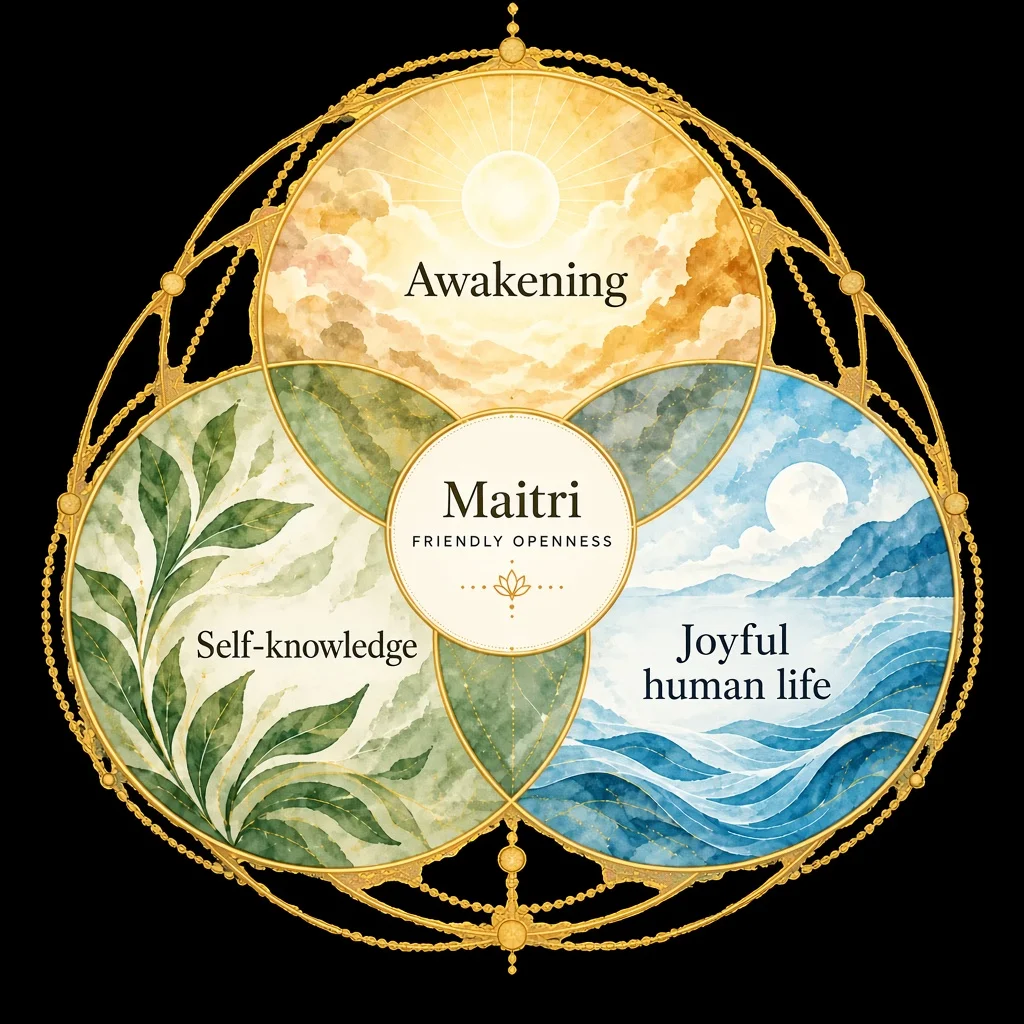
Three intersecting circles: awakening, self-knowledge, and joyful human life; Maitri at the center
03

Why Maitri?

In friendship with yourself and the world.

The Maitri program aims to open a sense of inner space, give us access to our strength and intelligence, and support a fuller acceptance of ourselves and the world. Maitri is a Sanskrit term meaning loving-kindness: a warm, friendly openness with which we embrace our experience and every state of mind in ourselves and others. This awake and friendly attitude is our own inner therapist.

Maitri can be a starting point both for our path of self-understanding and for spiritual practice, while also being a foundation for a fully lived human life. Without friendly acceptance of ourselves, our attempts to know or transcend ourselves can easily become a continuous struggle.

04

Where does this practice come from?

The mandala of the five Buddha families – in a form that can be directly experienced.

Chögyam Trungpa Rinpoche

Chögyam Trungpa Rinpoche

Where does this practice come from?

The roots of Maitri Space Awareness reach back to the early 1970s. The foundations of the practice grew from the meeting and shared thinking of Chögyam Trungpa Rinpoche and Shunryu Suzuki. Trungpa Rinpoche recognized that traditional silent sitting meditation could be difficult or even inaccessible for many people, especially those struggling with mental or emotional instability. With this challenge in mind, he envisioned the Maitri Project: a contemplative community in which coordinating body and mind, together with simple, grounding everyday activities, could help participants return to inner balance.

In his work, Trungpa Rinpoche brought ancient space-awareness techniques from Tibetan Vajrayana Buddhism into dialogue with Western therapeutic perspectives. The aim is not to change or suppress states of mind, but to allow confusion to transform into its essential, natural wisdom. As Trungpa taught, “the same energies that disturb us become forces that lead toward awakening and insight.”

Over the years, due to the inspiration and guidance of Marvin Casper, the practice became an integral part of contemplative psychotherapy training and many other departments at Naropa University. One of its central messages is that the “inner therapist” is none other than our own awake awareness. Through maitri, we learn to embrace our experience without judgment and recognise the basic sanity within us.

05

Arrival

There are many ways to arrive here – curiosity is enough.

You may have practiced for years, you may be a helping professional exploring where Buddhism and psychology meet, or you may simply want to understand your own patterns more deeply and find inspiration for your path.

You may find something familiar here if…

  • you are fascinated by human diversity and curious about the subtler layers of relationships, inner states, and ways of functioning;
  • you are an artist, maker, or someone moved by creative energy;
  • you are interested in movement, dance, or body awareness;
  • as a therapist or helping professional, you would like to explore the meeting point of Buddhist psychology and self-awareness work;
  • you already have some form of mindfulness-based practice – recommended, as the process can be intense;
  • you have a Buddhist or other spiritual practice and would like to experience its qualities more directly in everyday life.

You are also welcome if…

  • you do not yet know exactly what you are looking for, but the theme speaks to you;
  • you do not belong to a Buddhist community and come from another spiritual background, or from none at all;
  • you would like to ask questions and learn more before deciding.

Before the retreat, we will have an individual conversation in person or online so we can get to know one another and talk through any questions you may have.

06

The arc of the five days

Each day, a new quality. The same attention.

An urban retreat is not a turning away from everyday life. In the middle of the city, we give ourselves time and space to perceive the same world more slowly, openly, and directly.

09:00

Arrival and sitting meditation

We arrive in the body and the breath. The simplicity of sitting gives space to whatever is with us that day.

morning

Teaching and color–posture practice

We meet the energy of the day’s Buddha family through color, posture, and direct experience, leaving time for observation and sharing.

lunch

Break

Time to let things settle, eat, and walk. The neighborhood, the Danube, and the city can naturally become part of the practice.

afternoon

Artistic and movement practices

Using different forms of contemplative art (Dharma Art), we deepen our understanding of each quality.

17–18:00

Settling and sharing

At the end of the day, we return to what we experienced directly and allow the impressions to settle more quietly.

Practical details

Five interconnected days in Budapest.

Dates
January 2–6, 2027
Daily schedule
approx. 9:00–17:00/18:00
Venue
joyn* Budapest · 1056 Budapest, Váci utca 40.
Participation
The five days form one continuous arc; we encourage participation in the full retreat.
Participation Fee
  • Reduced: €200

    For those whose current financial circumstances make the standard fee difficult to afford.

  • Standard: €250

  • Sponsor: €300

    Your contribution helps make the retreat accessible to participants who need financial support.

  • Supported: If you would like to attend but the cost would be a barrier, please do not hesitate to request supported participation. Support is offered according to the sponsorship funds available.

I’m interested →
The space

A bright, simple zendo in the heart of the city.

The zendo on Váci Street is a bright practice space filled with natural light in the heart of the city. Ferenciek tere, the Danube, and the vibrant life of Budapest are only a few minutes away – close to everyday life, yet with enough space for quiet.

Venue website ↗
Alexandra MacKay Shenpen
07

Guest teacher

Alexandra MacKay Shenpen, PhD

Alexandra MacKay Shenpen, PhD, was born in Canada to Hungarian and Scottish ancestry. She has practiced Buddhism since 1978. Her first teacher was Chögyam Trungpa Rinpoche, whose inspiration led her to move to Boulder in 1981. There, under the guidance of Marvin Casper, one of Naropa University’s founders, she immersed herself deeply in Maitri Space Awareness practice and met her future husband, Lama Ugyen Shenpen. For more than three decades she taught at Naropa University, led meditation and contemplative arts retreats across North America and Europe, and supported clients as a contemplative psychotherapist.

She is an authorized ikebana/kadō teacher (Sensei) in the Sogetsu Ryū and Kalapa Ikebana lineages and has been a master instructor since 2013. Her new school, Kalapa Ohana Wa, nurtures the relationship between contemplative arts, nature, and human creativity.

Alexandra uniquely brings together the principles of Dharma Art with the five energies – five ways of perceiving and expressing experience.

Background on Alexandra Shenpen’s ikebana work ↗
08

Co-facilitators

Those accompanying the program

Peter Nowak

Peter Nowak, PhD

Vienna

Peter Nowak first met Chögyam Trungpa Rinpoche in 1985 and participated in the final three-month seminary taught by Trungpa Rinpoche in 1986.

He has three adult children and two stepchildren. For 35 years he worked on health-system reform and taught at several Austrian universities. In close cooperation with the Austrian Ministry of Health and the World Health Organization, he developed strategic initiatives and international networks, providing a rich field of practice for creating an enlightened society – with both successes and failures.

He serves on the leadership team of the Shambhala Center in Vienna, is a member of the Shambhala Global Board, and previously served on the Shambhala Europe Advisory Board.

He has been a meditation instructor since 1986 and has taught in numerous Maitri Space Awareness programs since 1999. In 2022, he taught the first Maitri program in Austria with his beloved Vienna “Maitri Travel Companion Team,” and has since led two further Maitri programs in Austria and Spain.

Boldog Dániel Zoltán

Boldog Dániel Zoltán

Organizer and host

Boldog Dániel Zoltán is the organizer of the program. He is a family constellations facilitator, contemplative self-awareness guide, and meditation instructor, as well as a coordinator of Dharma practice in the Shambhala and Sakyong lineages in Hungary. He is the father of two adult daughters and a proud grandfather.

He invited the teacher to this Budapest retreat, translates the Hungarian background materials, and is happy to help anyone interested. As host of the program, he stays in contact and accompanies participants throughout the registration process.

09

Community space

From one retreat a shared practice can grow.

Maitri Community is born from the intention to create an open space for practice and mutual support. This five-day retreat will be the seed we plant. What grows from it will depend on us, the participants.

It may continue through smaller practice groups, shared study, and further gatherings. We will follow where genuine need, attention, and shared energy move.

January 2027
urban retreat
→practice groups→emerging community
10

Continuation

Practice circle – after the retreat.

After the retreat, the shared work may continue in smaller practice groups, individual accompaniment, shared sitting and study, and further gatherings.

An inexhaustible treasury of Maitri Space Awareness, Dharma Art, Ikebana, and other Dharma applications awaits curious explorers.

11

Would you like to read more?

Library – the wider context of practice.

Here you will find translations about the background of Maitri Space Awareness and related contemplative traditions. Texts are added from time to time as they are completed.

01

Reading

Working with Our Emotions (excerpt from Marvin Casper)

Usually we are only vaguely aware of the emotional atmosphere in which we are constantly living. When something dramatic happens, we are often overwhelmed – becoming angry, hurt, or confused. We do not know where the emotion came from, so we try to control it or act impulsively. Yet if we attune ourselves to the subtleties of our emotional atmosphere, it becomes possible to see the arising of energy clearly and direct it intelligently, without panicked manipulation or blind action. The key is to see the situation panoramically and delicately – to know what is arising, both inside and outside – so that we can remain open and allow the energy to flow.

Sitting meditation develops the precision and panoramic awareness needed to work skillfully with emotions. During sitting meditation or space-awareness postures, thoughts and emotions that arise are simply regarded as phenomena. We do not evaluate them; we do not cultivate the “good” thoughts or suppress the “bad” ones. This practice interrupts our preoccupation with the stream of thought and allows us to become more aware of subtler feelings.

Of course, in five days we can only glimpse the richness of heightened awareness and compassion, but that glimpse can become powerful inspiration for further practice and exploration.

02

Translation

Coming soon

This space is still open – the translation is in progress.

03

Translation

Coming soon

This space is still open – the translation is in progress.

12

Frequently asked questions

Your questions are welcome!

A question is also a way of approaching. If something is not yet clear, you are welcome to stay with it and ask.

Send a question →
Do I need to be Buddhist?

No. Maitri Space Awareness comes from Buddhist, Vajrayana roots, but the practice works with direct experience. You are welcome with a Buddhist or other spiritual background, or with none at all.

Do I need meditation experience?

It is helpful if you already have some experience with a mindfulness-based or other meditation practice. If this is completely new to you, please get in touch. We are happy to offer a short introduction beforehand so you can attune to the retreat space.

Do I need to attend all five days?

The five days build on one another, so participating in the full arc can offer a richer experience and also supports the safety and continuity of the group space. If you can only attend for a shorter time, please contact us. We consider each request and situation individually.

What is the participation fee?

Reduced: €200, standard: €250, sponsor: €300. Supported participation with a contribution adjusted to individual circumstances, according to sponsorship funds available. See the practical details section; we can discuss further when you get in touch.

Is this therapy?

The retreat is not psychotherapeutic treatment. Maitri Space Awareness is closely connected with Buddhist psychology and contemplative psychotherapy, but here we encounter it as a contemplative practice of self-awareness.

What if I only have a question?

Your question is welcome. On the form you can choose “I still have questions.” Your question alone is reason enough to get in touch; you do not need to make a decision in advance.

PRIVACY